
One of the most common—and deceptively simple—questions in AI & ML interviews is:
“Can you explain the difference between supervised, unsupervised, and reinforcement learning?”
While it appears basic, interviewers use this question to evaluate how you conceptualize learning problems, choose modeling approaches, and design intelligent systems aligned with real-world constraints. The goal is not to recite definitions, but to demonstrate decision-making maturity.
The Core Distinction: How Does the System Learn?
At a high level, the difference between these paradigms lies in how feedback is provided to the learning system.
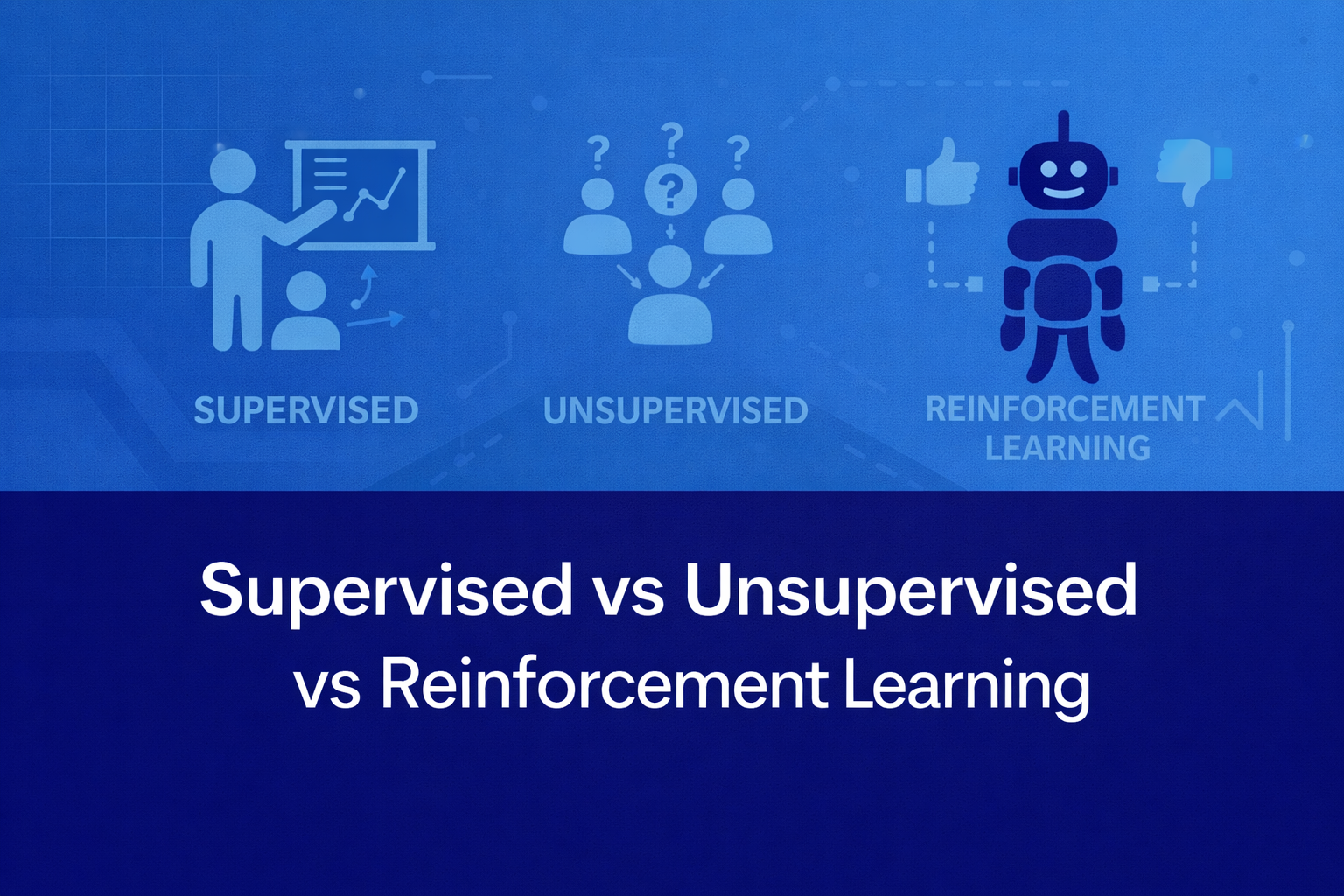
- Supervised Learning learns from labeled examples
- Unsupervised Learning discovers structure without labels
- Reinforcement Learning learns through interaction and reward
Understanding this feedback mechanism is key to choosing the right approach.
Supervised Learning: Learning With Ground Truth
What It Is
Supervised learning involves training a model on labeled data, where each input has a known output.
The model learns a mapping from inputs to outputs by minimizing prediction error.
Typical Problems
- Classification (spam detection, fraud detection)
- Regression (price prediction, demand forecasting)
Common Algorithms
- Linear and logistic regression
- Decision trees and random forests
- Support Vector Machines
- Neural networks
Impact on Model Design
Supervised learning requires:
- High-quality labeled datasets
- Clearly defined success metrics
- Careful handling of bias and imbalance
Label availability often becomes the biggest bottleneck in real systems.
Interview Insight
Interviewers expect you to:
- Discuss label quality, not just quantity
- Choose evaluation metrics aligned with business impact
- Acknowledge risks like data leakage
Supervised learning is the default choice—but not always the right one.
Unsupervised Learning: Discovering Hidden Structure
What It Is
Unsupervised learning works with unlabeled data, aiming to uncover patterns, groupings, or representations without explicit outcomes.
The system learns structure rather than predictions.
Typical Problems
- Customer segmentation
- Anomaly detection
- Topic modeling
- Dimensionality reduction
Common Algorithms
- K-Means, DBSCAN
- Hierarchical clustering
- PCA, t-SNE, autoencoders
Impact on Model Design
Unsupervised learning introduces ambiguity:
- No ground truth for validation
- Results are often exploratory
- Evaluation relies on domain interpretation
It is frequently used as:
- A preprocessing step
- A discovery tool
- A monitoring mechanism
Interview Insight
Strong candidates mention:
- How results will be validated or interpreted
- How unsupervised outputs feed downstream systems
- Risks of over-interpreting clusters
Unsupervised learning is about insight, not prediction.
Reinforcement Learning: Learning Through Interaction
What It Is
Reinforcement Learning (RL) involves an agent that learns by interacting with an environment, receiving rewards or penalties based on actions.
The goal is to learn a policy that maximizes long-term reward.
Key Components
- Agent
- Environment
- State
- Action
- Reward
Typical Problems
- Game playing
- Robotics and control systems
- Recommendation optimization
- Autonomous decision-making
Common Algorithms
- Q-Learning
- Policy Gradient methods
- Deep Q-Networks (DQN)
- Proximal Policy Optimization (PPO)
Impact on Model Design
RL introduces unique challenges:
- Delayed feedback
- Exploration vs exploitation trade-offs
- Simulation requirements
- Safety constraints
RL systems are harder to debug and deploy than supervised models.
Interview Insight
Interviewers do not expect deep RL expertise—but they do expect:
- Awareness of when RL is appropriate
- Recognition of operational risk
- Understanding of reward design challenges
RL is powerful, but rarely the first choice in enterprise systems.
Side-by-Side Comparison
| Aspect | Supervised | Unsupervised | Reinforcement |
|---|---|---|---|
| Feedback | Explicit labels | None | Reward signal |
| Goal | Predict outcomes | Discover structure | Optimize behavior |
| Data Requirement | Labeled data | Unlabeled data | Environment interaction |
| Evaluation | Metrics-driven | Interpretive | Long-term reward |
| Complexity | Medium | Medium | High |
| Typical Use | Prediction tasks | Exploration, insights | Decision optimization |
Interviewers care less about memorizing this table—and more about how you use it to justify decisions.
Choosing the Right Paradigm: Interview PerspectiveStrong candidates frame their choice like this:
“If labeled data exists and prediction is the goal, supervised learning is appropriate. If we lack labels but want insight, unsupervised learning helps. If the system must make sequential decisions with feedback over time, reinforcement learning becomes relevant.”
This shows conceptual clarity and architectural thinking.
Common Interview Mistakes
❌ Treating all problems as supervised learning
❌ Using reinforcement learning unnecessarily
❌ Ignoring evaluation challenges in unsupervised learning
❌ Failing to discuss data constraints
These mistakes signal academic thinking, not production readiness.
Real-World Systems Are Often Hybrid
In practice, intelligent systems combine paradigms:
- Unsupervised learning for feature discovery
- Supervised learning for prediction
- Reinforcement learning for optimization
Interviewers are impressed when candidates recognize that paradigms coexist, rather than compete.
Final Thought: Learning Paradigms Shape System Behavior
This question is not about definitions—it’s about how learning strategy impacts system design, risk, and scalability.
If you can:
- Choose the right paradigm
- Justify the trade-offs
- Anticipate operational challenges
You demonstrate the mindset of someone ready to build real AI systems—not just answer interview questions.