
In machine learning, the ultimate goal is not to perform well on training data — it is to perform well on unseen data.
Overfitting and underfitting are two failure modes that prevent this from happening.
When interviewers ask about these concepts, they are evaluating whether you understand:
- The relationship between model complexity and generalization
- How to diagnose training behavior
- How to fix models systematically rather than randomly
1. What is Underfitting?
Definition
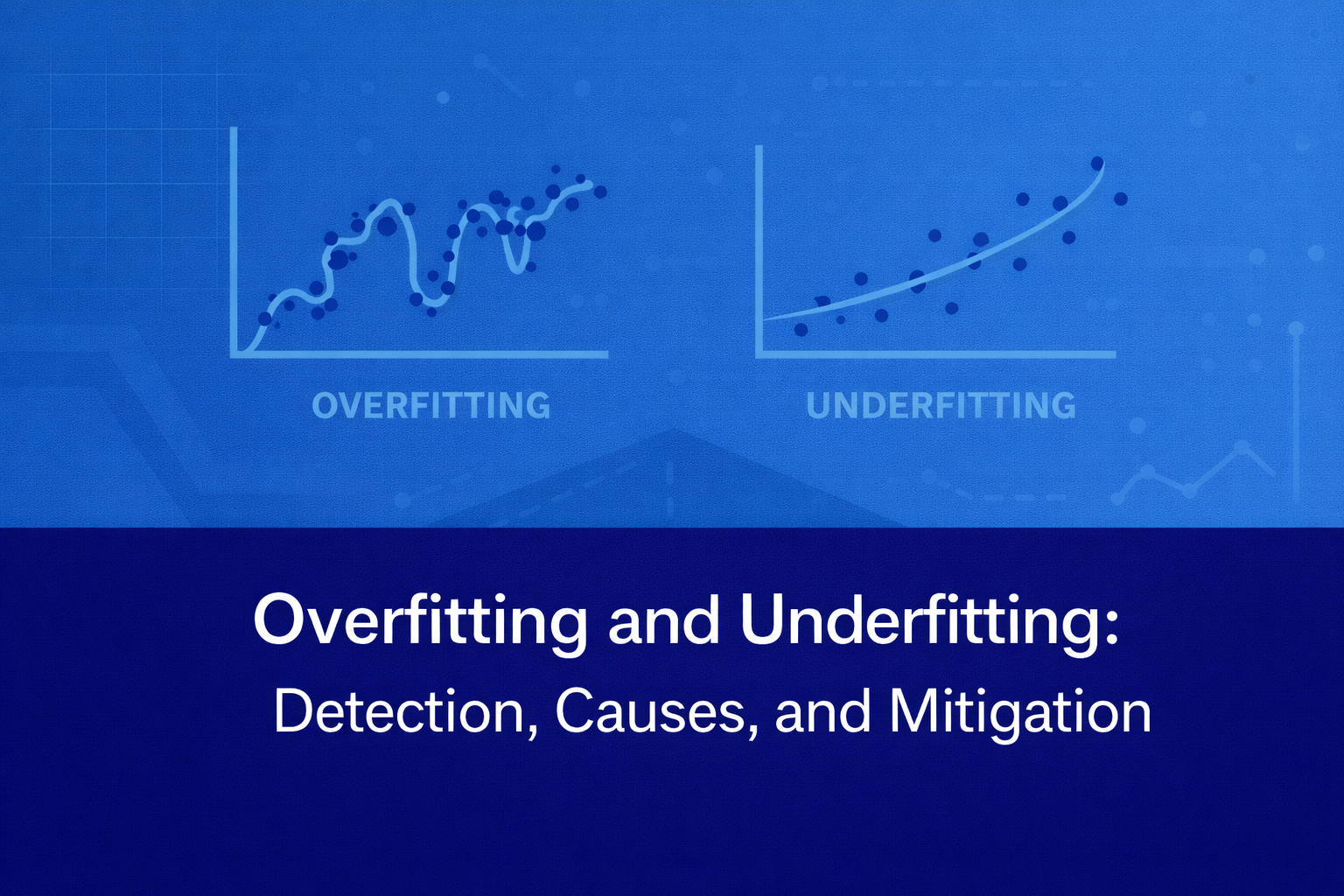
Underfitting occurs when a model is too simple to capture the underlying structure of the data.
It fails to learn important patterns.
The model has high bias and low variance.
Symptoms of Underfitting
- High training error
- High validation error
- Similar performance on both datasets
- Poor predictive performance overall
If your model performs badly even on training data, it is underfitting.
Why Underfitting Happens
Common causes:
- Model too simple (e.g., linear model for nonlinear data)
- Insufficient features
- Over-regularization
- Too few training iterations
- Poor feature engineering
Example
Imagine modeling house prices using only square footage, ignoring:
- Location
- Age of property
- Amenities
Even with lots of data, the model cannot learn complex relationships.
That’s underfitting.
Interview Insight
Strong candidates say:
“If both training and validation errors are high and similar, the model likely lacks representational capacity.”
That signals maturity.
2. What is Overfitting?
Definition
Overfitting occurs when a model learns not only the true patterns but also the noise in the training data.
It performs well on training data but poorly on new data.
The model has low bias and high variance.
Symptoms of Overfitting
- Very low training error
- High validation/test error
- Large gap between training and validation performance
This is the classic “memorization problem.”
Why Overfitting Happens
Common causes:
- Model too complex
- Small dataset
- Too many features
- No regularization
- Excessive training
- Data leakage
Example
A deep neural network trained on 500 data points:
- 100% training accuracy
- 65% validation accuracy
The model has memorized the training examples.
Interview Insight
Strong candidates add:
“Overfitting often indicates that the hypothesis space is too large relative to the dataset size.”
That’s a production-level explanation.
3. The Training vs Validation Curve Perspective
Interviewers love when candidates describe this intuitively.
Underfitting Pattern
Training Error: High
Validation Error: High
Gap: Small
Overfitting Pattern
Training Error: Low
Validation Error: High
Gap: Large
Good Fit Pattern
Training Error: Low
Validation Error: Low
Gap: Small
Being able to explain this verbally shows deep intuition.
4. Why This Matters in Production
Overfitting and underfitting are not academic issues.
They directly impact:
- Customer experience
- Fraud detection reliability
- Medical diagnosis accuracy
- Revenue optimization
- Operational stability
An overfitted fraud model:
- Generates too many false alarms
- Creates alert fatigue
An underfitted medical model:
- Misses critical diagnoses
Both are dangerous — for different reasons.
5. How to Fix Underfitting
If the model is underfitting:
Increase Model Capacity
- Use nonlinear models
- Add polynomial terms
- Use deeper architectures
Improve Features
- Feature engineering
- Add domain knowledge features
Reduce Regularization
- Lower L1/L2 penalties
- Reduce dropout rate
Train Longer
- More iterations (if prematurely stopped)
6. How to Fix Overfitting
If the model is overfitting:
Add More Data
Most powerful solution.
Regularization
- L1 / L2 penalties
- Dropout (deep learning)
- Weight decay
Reduce Model Complexity
- Shallower tree
- Smaller network
- Fewer features
Cross-Validation
Ensure robust performance estimation.
Early Stopping
Stop training when validation error increases.
Data Augmentation
Especially in computer vision.
7. Relationship to Bias–Variance
Underfitting = High Bias
Overfitting = High Variance
But here’s the nuance:
- Bias and variance describe error components
- Overfitting and underfitting describe observed behavior
Strong candidates understand both layers.
8. Common Interview Mistakes
❌ Saying “overfitting means 100% training accuracy”
(Not always true.)
❌ Confusing data leakage with overfitting
(Data leakage is worse.)
❌ Suggesting “always use deep learning”
(Complexity increases overfitting risk.)
❌ Ignoring regularization strategies
9. Real Interview Scenario
Interviewer:
“Your model has 98% training accuracy but 78% validation accuracy. What would you do?”
Strong structured response:
- Confirm no data leakage
- Check class imbalance
- Add regularization
- Simplify model
- Try cross-validation
- Increase dataset size if possible
That systematic reasoning is what interviewers reward.
10. Advanced Perspective: Overfitting Is Not Always Bad
In large models (e.g., deep networks), models can:
- Perfectly fit training data
- Still generalize well
This challenges classical intuition.
Modern ML shows that:
- Overparameterized models can generalize under certain regimes
- Implicit regularization plays a role
Mentioning this in senior interviews shows depth.
Final Thought: Generalization Is the Goal
Overfitting and underfitting are symptoms of imbalance between:
- Model complexity
- Data availability
- Regularization strength
The goal is not:
- Lowest training error
- Most complex model
The goal is:
Stable, reliable performance on unseen data.
If you can explain:
- What they are
- How to diagnose them
- How to fix them
- Why they matter operationally
You demonstrate readiness to build AI systems that survive beyond demos.