
Few topics expose shallow understanding in interviews faster than the question:
“What is the difference between AI, Machine Learning, and Deep Learning?”
On the surface, this sounds basic. In reality, interviewers use this question to assess conceptual clarity, systems thinking, and the ability to reason beyond buzzwords. Strong candidates treat this not as a definitions question, but as an opportunity to demonstrate architectural and decision-making maturity.
The Big Picture: A Hierarchy, Not Three Separate Things
The most important insight—often missed—is this:
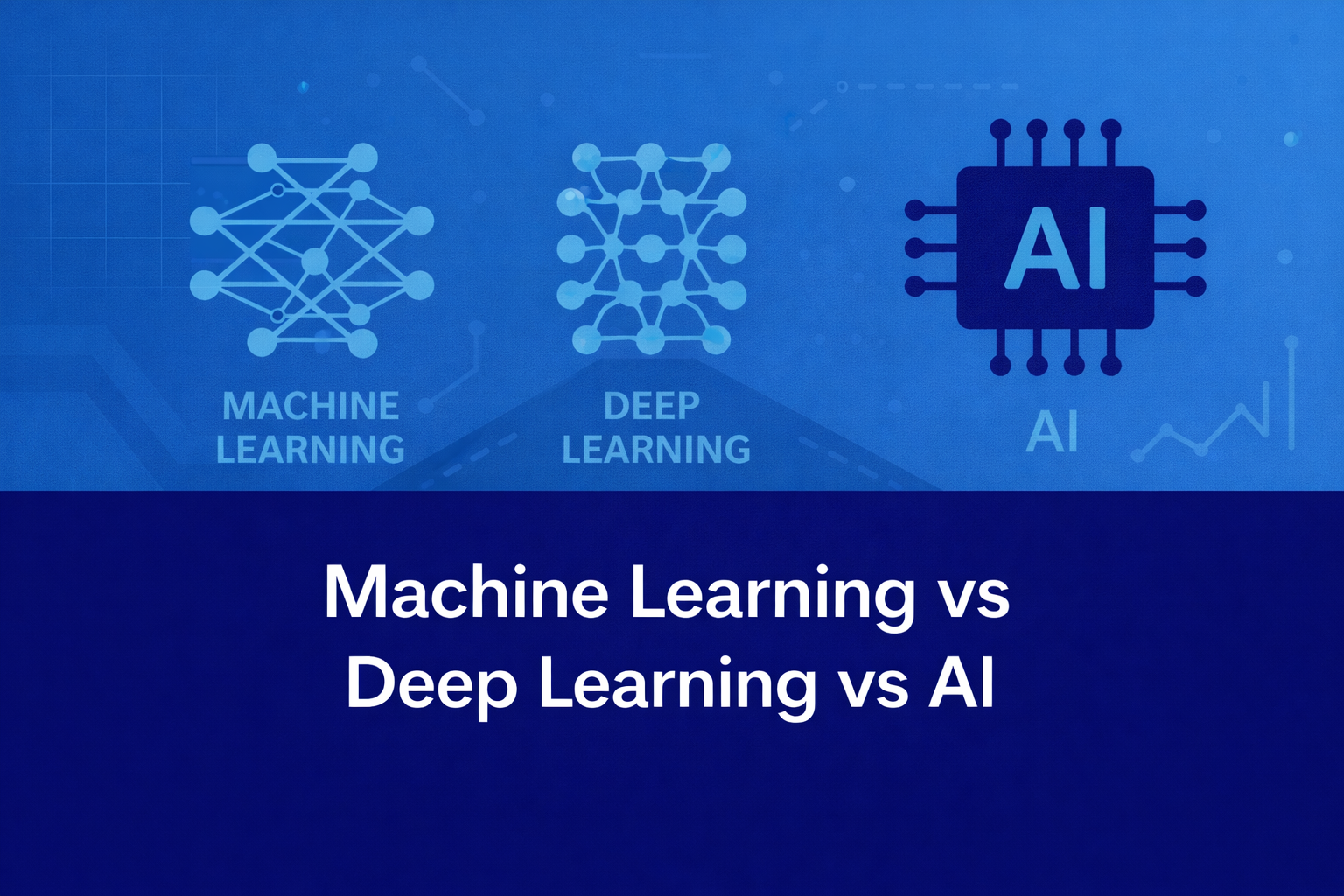
Artificial Intelligence is the umbrella. Machine Learning is a subset of AI. Deep Learning is a subset of Machine Learning.
They are not competing approaches, nor interchangeable terms.
Understanding this hierarchy immediately sets a strong foundation for deeper discussion.
Artificial Intelligence (AI): The Goal
What AI Really Means in Practice
Artificial Intelligence refers to systems designed to exhibit intelligent behavior, such as:
- Reasoning and decision-making
- Learning from experience
- Perception and language understanding
- Acting autonomously toward a goal
Crucially, AI does not require learning.
Examples of AI that are not Machine Learning:
- Rule-based expert systems
- Search and planning algorithms
- Heuristic-driven game engines
- Deterministic decision trees coded by humans
Interviewer Insight
When interviewers hear “AI,” they think:
- System behavior
- Autonomy
- Decision logic
- Real-world impact
Not models.
Machine Learning (ML): Learning From Data
What ML Adds to AI
Machine Learning is a technique within AI where:
Systems learn patterns from data instead of being explicitly programmed.
Key characteristics:
- Requires historical data
- Improves performance through experience
- Relies on statistical learning
Common ML approaches:
- Supervised learning (classification, regression)
- Unsupervised learning (clustering, dimensionality reduction)
- Reinforcement learning (policy optimization)
Practical Examples
- Spam detection
- Credit risk scoring
- Recommendation systems
- Fraud detection
Interviewer Lens
When ML is discussed, interviewers evaluate:
- Data understanding
- Feature engineering
- Model selection rationale
- Evaluation metrics
ML is where engineering judgment starts to matter.
Deep Learning (DL): Representation Learning at Scale
What Makes Deep Learning Different
Deep Learning is a specialized subset of ML that uses multi-layer neural networks to automatically learn complex representations.
What sets DL apart:
- Requires large volumes of data
- Computationally expensive
- Learns features automatically
- Excels in unstructured data (images, audio, text)
Examples:
- Image recognition
- Speech-to-text
- Large language models
- Autonomous perception systems
Key Trade-Off
Deep Learning trades:
- Interpretability for performance
- Simplicity for scale
- Manual features for learned representations
Interviewer Expectation
Senior candidates never default to deep learning without justification.
A strong answer includes:
“Deep learning may be suitable here due to unstructured data, but I’d validate whether simpler models meet the requirement first.”
A Comparison That Interviewers Love
| Aspect | AI | Machine Learning | Deep Learning |
|---|---|---|---|
| Scope | Broad | Subset of AI | Subset of ML |
| Learning Required | No | Yes | Yes |
| Data Dependency | Optional | High | Very High |
| Feature Engineering | Manual | Mostly manual | Automatic |
| Interpretability | High | Medium | Low |
| Compute Cost | Low–Medium | Medium | High |
| Typical Use Cases | Planning, rules | Prediction, classification | Vision, NLP, speech |
This table isn’t about memorization—it’s about trade-off awareness.
Why Interviewers Ask This Question
This question is a gateway, not a destination.
Interviewers are checking:
- Can you explain concepts clearly?
- Do you understand when not to use deep learning?
- Can you align technology with business constraints?
Candidates who answer in definitions alone rarely pass follow-ups.
Common Interview Mistakes
❌ Treating AI, ML, and DL as synonyms
❌ Assuming deep learning is always superior
❌ Ignoring data and infrastructure constraints
❌ Failing to mention interpretability or cost
These signal immaturity, not lack of knowledge.
How Strong Candidates Frame Their Answer
A senior-level framing often sounds like this:
“AI is the overarching goal of building intelligent systems. Machine learning is one way to achieve that by learning from data, and deep learning is a powerful subset of ML that excels with large-scale, unstructured data—but it comes with higher cost and lower explainability.”
This single paragraph answers:
- What they are
- How they relate
- When to use them
- Why trade-offs matter
Real-World Perspective: Choosing the Right Level
In production systems:
- AI defines the system behavior
- ML provides adaptive intelligence
- DL is used selectively where complexity demands it
Most successful AI systems are hybrid, combining:
- Rules for safety
- ML for prediction
- DL for perception
Interviewers look for candidates who understand this balance.
Final Thought: Clarity Signals Competence
This question is not testing knowledge—it is testing clarity of thought.
If you can:
- Explain the hierarchy
- Articulate trade-offs
- Resist over-engineering
You demonstrate the mindset of someone who builds systems, not demos.
And that is exactly what interviewers are looking for.