
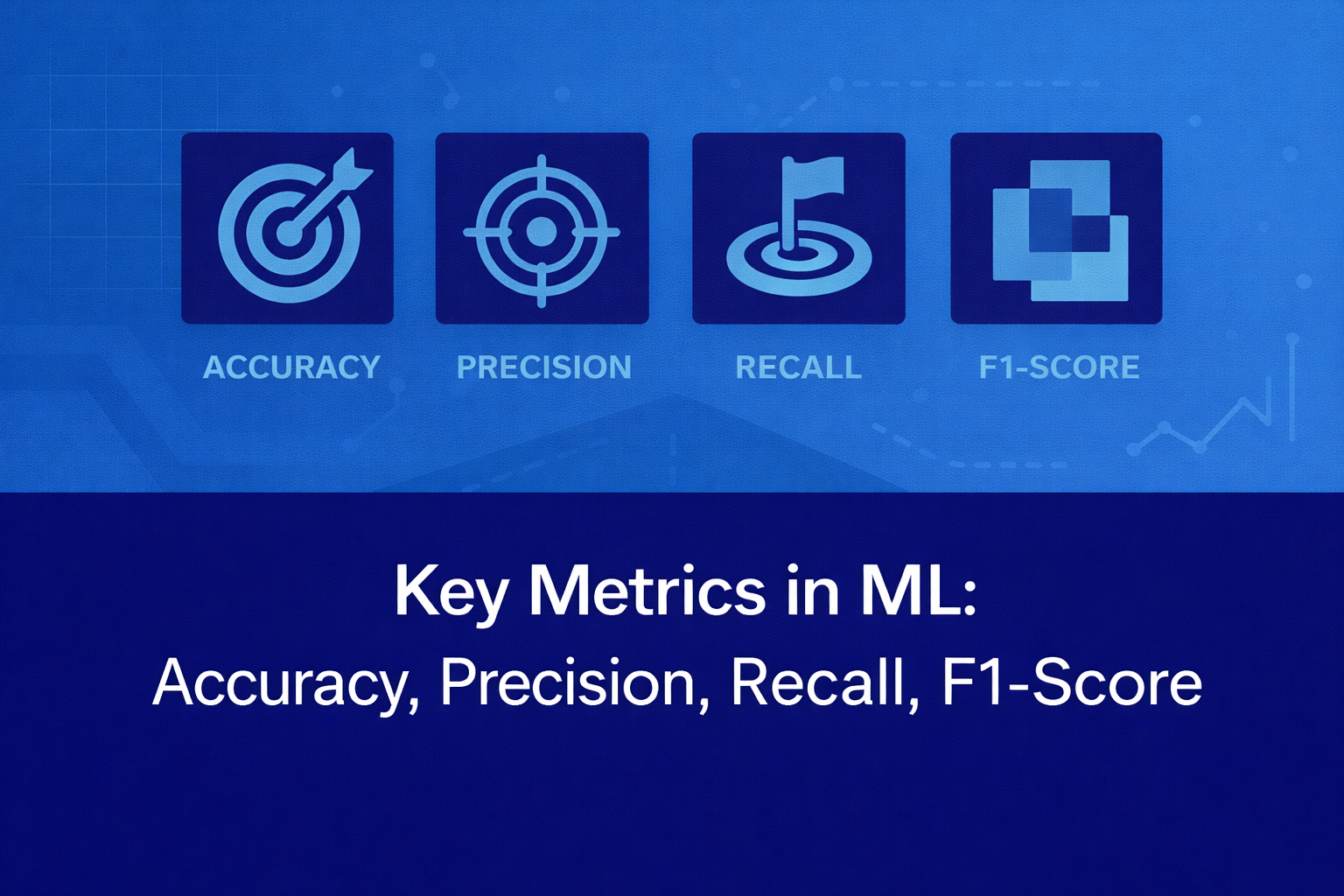
In Machine Learning interviews, evaluation metrics are not just a technical detail—they are a window into how you think about outcomes, risk, and real-world impact. Interviewers often ask about accuracy, precision, recall, and F1-score not to test formulas, but to assess whether you understand what success actually means for an intelligent system.
A model that performs well on paper but fails in production is often the result of choosing the wrong metric.
Why Metrics Matter More Than Models
Many candidates focus heavily on model selection:
- Logistic regression vs XGBoost
- Random forest vs neural network
But in real systems, metrics define behavior.
“What you optimize for is what your system learns to prioritize.”
Interviewers know this—and that’s why metric-related questions are common and often layered with follow-ups.
The Foundation: Confusion Matrix
All four metrics are derived from the confusion matrix, which captures prediction outcomes:
- True Positive (TP): Correct positive prediction
- False Positive (FP): Incorrect positive prediction
- True Negative (TN): Correct negative prediction
- False Negative (FN): Incorrect negative prediction
Understanding these four values is more important than memorizing formulas.
Accuracy: Overall Correctness
Definition
Accuracy measures the proportion of total predictions the model got right.Accuracy=TP+TN+FP+FNTP+TN
When Accuracy Works Well
- Balanced datasets
- Equal cost of false positives and false negatives
When Accuracy Fails
Accuracy becomes misleading when:
- Classes are imbalanced
- One type of error is more costly than the other
Example:
- 99% non-fraud transactions
- A model predicting “non-fraud” always gets 99% accuracy—but is useless
Interview Insight
Strong candidates say:
“Accuracy alone is insufficient for imbalanced datasets.”
That sentence alone signals maturity.
Precision: How Reliable Are Positive Predictions?
Definition
Precision measures how many predicted positives are actually correct.Precision=TP+FPTP
When Precision Matters
- False positives are expensive or harmful
Examples:
- Spam filtering (legitimate email flagged)
- Fraud alerts that block real customers
- Medical tests that cause unnecessary panic
High Precision Means
“When the model says yes, it’s usually right.”
Interview Insight
Interviewers look for alignment between:
- Precision
- Business or user impact
Recall: How Many Actual Positives Did We Catch?
Definition
Recall (also called sensitivity) measures how many actual positives were correctly identified.Recall=TP+FNTP
When Recall Matters
- Missing positives is dangerous
Examples:
- Fraud detection
- Disease screening
- Intrusion detection
High Recall Means
“We catch most of the real positives—even if we raise some false alarms.”
Interview Insight
Strong answers mention risk tolerance:
“In safety-critical systems, recall often matters more than precision.”
Precision vs Recall: The Core Trade-Off
Increasing precision often decreases recall—and vice versa.
This trade-off is controlled by:
- Decision thresholds
- Business priorities
- Risk appetite
Interviewers care deeply about whether you can articulate this trade-off clearly.
F1-Score: Balancing Precision and Recall
Definition
F1-score is the harmonic mean of precision and recall.F1=2×Precision+RecallPrecision×Recall
Why Harmonic Mean?
It penalizes extreme imbalance—high precision with low recall (or vice versa) results in a low F1 score.
When F1 Is Useful
- Imbalanced datasets
- When both false positives and false negatives matter
- When a single summary metric is needed
Interview Insight
Senior candidates often say:
“F1 is useful when we need balance, but I’d still inspect precision and recall individually.”
That shows nuance.
Choosing the Right Metric: Interview Perspective
Interviewers expect context-driven metric selection, not blanket answers.
Example Scenarios
| Use Case | Priority Metric | Reason |
|---|---|---|
| Fraud Detection | Recall | Missing fraud is costly |
| Spam Filtering | Precision | Avoid blocking real emails |
| Medical Screening | Recall | False negatives are dangerous |
| Recommendation Systems | Precision | User trust matters |
| Search Ranking | Precision@K | Top results matter |
What matters is how you justify the choice, not the metric itself.
Common Interview Mistakes
❌ Saying “accuracy is the main metric”
❌ Ignoring class imbalance
❌ Failing to connect metrics to business impact
❌ Treating F1 as a magic number
These mistakes suggest theoretical understanding without practical experience.
How Interviewers Evaluate Metric Answers
They look for:
- Clear explanation without formulas overload
- Business-aligned reasoning
- Awareness of trade-offs
- Ability to defend metric choice under follow-ups
A strong response often includes:
“I’d choose the metric based on which error is more costly in this context.”
Real-World Practice: Metrics Shape System Behavior
Metrics influence:
- Threshold tuning
- Alert fatigue
- Customer experience
- Operational cost
In production, metric misalignment causes:
- Excessive false alarms
- Missed critical events
- Loss of user trust
Interviewers know this—and want to see that you do too.
Final Thought: Metrics Are a Design Decision
Accuracy, precision, recall, and F1-score are not just evaluation tools—they are design choices that encode business priorities into models.
If you can:
- Explain them clearly
- Choose wisely
- Defend trade-offs
You demonstrate readiness to build AI systems that matter—not just models that score well.