
Techniques for Analyzing and Forecasting Sequential Data
Abstract
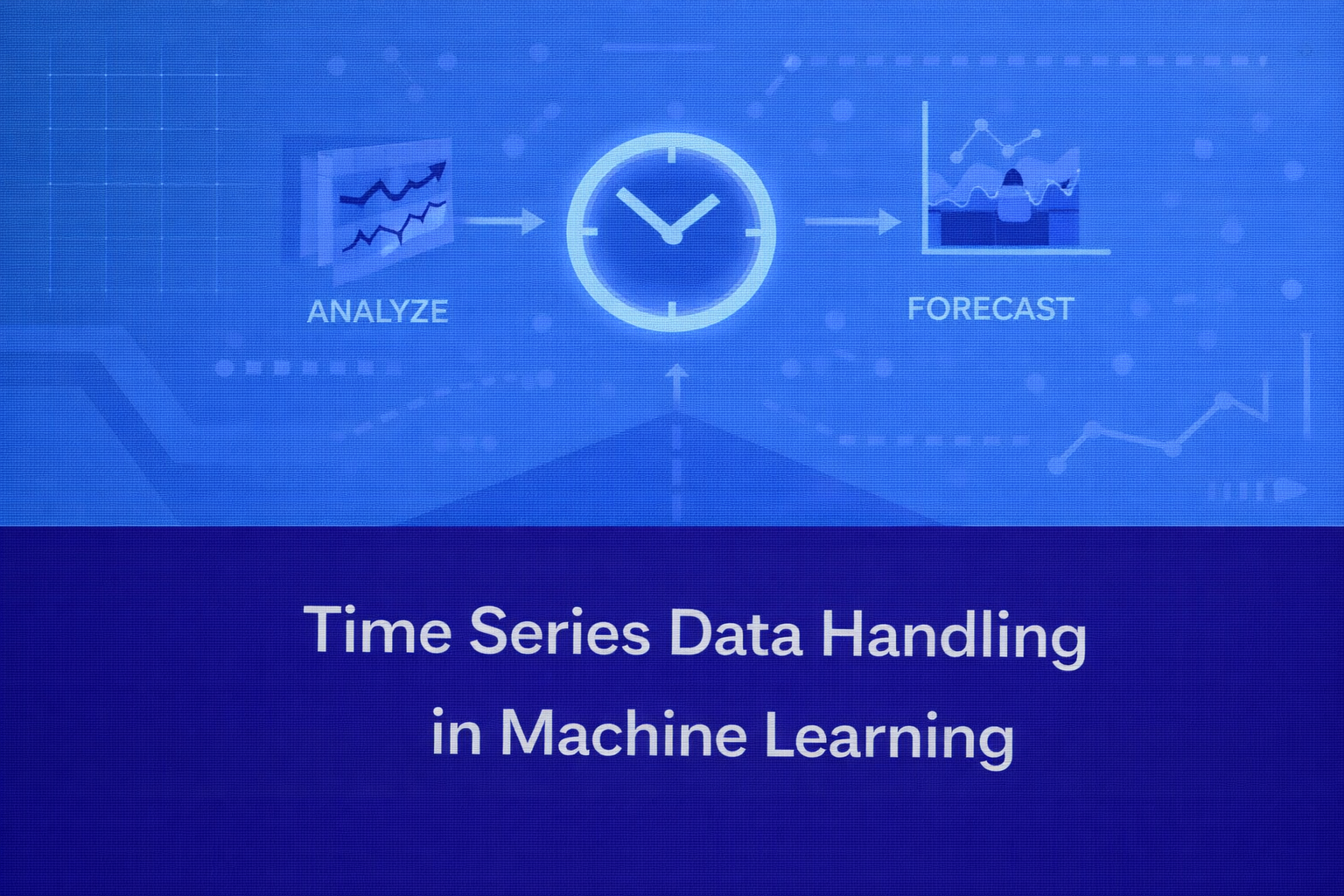
Time series data represents observations recorded sequentially over time. Unlike traditional datasets where observations are independent, time series data contains temporal dependencies, meaning past values influence future values. Such data is common in domains like finance, weather forecasting, healthcare monitoring, and demand prediction. Handling time series data requires specialized analytical techniques to capture patterns such as trends, seasonality, and temporal correlations. This article explains the characteristics of time series data, preprocessing steps, modeling approaches, and forecasting techniques used to analyze and predict sequential data effectively.
Introduction
In many real-world applications, data is collected continuously over time. Examples include:
- stock market prices recorded every second
- daily temperature measurements
- hourly electricity consumption
- monthly sales reports
- patient heart rate monitoring
These datasets are known as time series data, where each observation is associated with a specific timestamp.
Time series analysis focuses on understanding the structure of such data and predicting future values based on historical patterns.
Unlike standard machine learning datasets, time series observations are not independent, and their ordering plays a critical role in modeling.
Handling time series data requires special preprocessing techniques and models that capture temporal relationships.
Characteristics of Time Series Data
Time series data often contains distinct patterns that influence future values.
Trend
A trend represents the long-term movement in a dataset.
For example:
- increasing global temperatures over decades
- growth in company revenue over years
- increasing number of online users over time
Trends show whether the data generally increases, decreases, or remains stable over time.
Seasonality
Seasonality refers to repeating patterns occurring at regular intervals.
Examples include:
- higher retail sales during holiday seasons
- increased electricity demand during summer
- daily traffic peaks during rush hours
Seasonal patterns help models understand periodic fluctuations.
Cyclic Patterns
Cyclic patterns resemble seasonality but occur at irregular intervals.
Examples include:
- economic boom and recession cycles
- long-term business cycles
- population growth changes over decades
These cycles are influenced by broader external factors.
Noise
Noise represents random fluctuations in the dataset that cannot be explained by trends or seasonal patterns.
Noise may result from measurement errors, random events, or unpredictable changes.
Separating meaningful patterns from noise is an important goal of time series analysis.
Structure of Time Series Data
Time series datasets typically contain two key components:
- a timestamp or time index
- a measured value associated with that timestamp
For example:
Date | Sales
Jan 1 | 200
Jan 2 | 220
Jan 3 | 210
The order of observations is crucial because each value depends on previous values.
Preprocessing Time Series Data
Before building forecasting models, time series data must be properly prepared.
Handling Missing Time Points
Time series datasets may contain missing timestamps due to data collection issues.
Common strategies include:
- interpolation using nearby values
- forward filling previous observations
- backward filling future observations
Maintaining consistent time intervals is important for accurate modeling.
Resampling
Resampling adjusts the frequency of time series data.
For example:
- converting hourly data to daily averages
- aggregating daily sales into monthly totals
Resampling allows analysts to study patterns at different time resolutions.
Smoothing
Smoothing techniques reduce noise and highlight underlying patterns.
Common smoothing methods include:
- moving averages
- exponential smoothing
These methods help identify trends and seasonal components more clearly.
Stationarity
Many time series models assume that statistical properties such as mean and variance remain constant over time.
A dataset satisfying this property is called stationary.
Non-stationary data may contain trends or seasonal patterns that change over time.
Techniques used to achieve stationarity include:
- differencing
- detrending
- seasonal adjustments
Ensuring stationarity improves the performance of many forecasting models.
Feature Engineering for Time Series
Feature engineering helps extract useful information from time-based datasets.
Lag Features
Lag features represent past observations used to predict future values.
For example:
Sales_t = current sales
Sales_t-1 = previous day sales
Sales_t-7 = sales one week ago
These features allow models to capture temporal dependencies.
Rolling Statistics
Rolling statistics calculate summary measures over moving windows.
Examples include:
- rolling averages
- rolling standard deviation
- rolling maximum or minimum values
These features capture local patterns within the data.
Time-Based Features
Additional features derived from timestamps include:
- day of the week
- month of the year
- quarter of the year
- holiday indicators
These features help models capture seasonal behaviors.
Time Series Forecasting Methods
Several techniques exist for forecasting time series data.
These approaches range from classical statistical models to modern machine learning methods.
Moving Average Models
Moving averages compute the average of recent observations to smooth fluctuations.
They help identify trends and short-term patterns.
Although simple, moving averages are often used as baseline forecasting models.
Autoregressive Models
Autoregressive (AR) models predict future values based on previous observations.
For example, the value at time t may depend on values at times t-1, t-2, and so on.
These models capture temporal dependencies in time series data.
ARIMA Models
ARIMA (AutoRegressive Integrated Moving Average) is one of the most widely used statistical forecasting models.
It combines three components:
Autoregression
Using previous observations as predictors.
Differencing
Removing trends to achieve stationarity.
Moving Average
Modeling error terms from previous predictions.
ARIMA models are particularly effective for univariate time series forecasting.
Seasonal ARIMA (SARIMA)
SARIMA extends ARIMA by incorporating seasonal patterns.
This model captures repeating patterns that occur at fixed intervals, such as monthly or yearly seasonality.
SARIMA is commonly used in retail sales forecasting and climate modeling.
Exponential Smoothing Models
Exponential smoothing assigns greater weight to recent observations.
Variants include:
- simple exponential smoothing
- Holt’s linear trend method
- Holt-Winters seasonal method
These models are widely used in demand forecasting.
Machine Learning Approaches for Time Series
Machine learning models can also be used for time series forecasting.
These models treat forecasting as a supervised learning problem.
Regression-Based Models
Regression models can use lag features and time-based features to predict future values.
Examples include:
- linear regression
- random forests
- gradient boosting models
These models work well when many explanatory variables are available.
Recurrent Neural Networks
Recurrent Neural Networks (RNNs) are designed to handle sequential data.
They maintain internal memory that allows them to capture temporal relationships.
Variants include:
- Long Short-Term Memory networks (LSTM)
- Gated Recurrent Units (GRU)
These architectures are widely used in complex forecasting tasks such as financial markets and speech recognition.
Transformer Models
Modern transformer-based architectures can also analyze sequential data.
These models capture long-range dependencies and are increasingly used in advanced time series forecasting.
Evaluation of Time Series Models
Evaluating time series models differs from traditional machine learning evaluation.
Since data is sequential, random splitting of datasets may break temporal relationships.
Instead, evaluation methods such as time-based train-test splits are used.
Common forecasting metrics include:
- Mean Absolute Error (MAE)
- Mean Squared Error (MSE)
- Root Mean Squared Error (RMSE)
- Mean Absolute Percentage Error (MAPE)
These metrics measure the accuracy of predicted values compared to actual observations.
Real-World Applications
Time series analysis is widely used across industries.
Finance
Financial institutions analyze historical price data to forecast stock movements and detect anomalies.
Energy
Energy providers predict electricity demand to optimize resource allocation.
Retail
Retail companies forecast product demand to manage inventory and supply chains.
Healthcare
Medical systems analyze patient monitoring data to detect health abnormalities.
Transportation
Traffic management systems analyze vehicle flow patterns to reduce congestion.
These applications demonstrate the importance of time series forecasting in decision-making.
Challenges in Time Series Analysis
Time series modeling presents several challenges.
Data may exhibit complex seasonal patterns, sudden shocks, or structural changes over time.
External factors such as economic events, weather conditions, or policy changes may also affect time series patterns.
Handling these complexities requires careful model selection and continuous monitoring.
Best Practices for Handling Time Series Data
Effective time series analysis follows several best practices.
First, always visualize the data to understand trends and seasonal patterns.
Second, ensure consistent time intervals and handle missing timestamps appropriately.
Third, test for stationarity and apply transformations if necessary.
Fourth, engineer lag and rolling features to capture temporal dependencies.
Finally, evaluate models using time-based validation techniques.
Conclusion
Time series data plays a vital role in many real-world machine learning applications where observations are recorded over time. Unlike traditional datasets, time series data contains temporal dependencies that require specialized analysis and modeling techniques.
By identifying patterns such as trends, seasonality, and noise, practitioners can build models that forecast future values with greater accuracy. Techniques such as ARIMA, exponential smoothing, regression models, and neural networks provide powerful tools for analyzing sequential data.
Proper preprocessing, feature engineering, and model evaluation are essential for successful time series forecasting. As industries continue to rely on predictive analytics for planning and decision-making, effective time series data handling will remain a fundamental skill in modern machine learning and data science.