
Methods for Gathering Data: APIs, Web Scraping, and Public Datasets
Abstract
Data collection is a critical step in the machine learning lifecycle, as the quality, quantity, and relevance of data directly influence model performance. Before any algorithm can be trained, organizations must first gather reliable datasets from various sources. These sources may include internal databases, external APIs, web scraping techniques, and publicly available datasets. Each method presents unique advantages, technical challenges, and ethical considerations. This paper provides a detailed explanation of common data collection methods used in machine learning projects, focusing on APIs, web scraping, and public datasets. It also discusses how these sources integrate into machine learning pipelines and the best practices for ensuring data reliability and compliance.
Introduction
Machine learning systems depend on data to discover patterns, learn relationships, and make predictions. However, data rarely exists in a ready-to-use format. It must first be collected, processed, and validated before it can be used for training models.
Organizations obtain data from multiple sources, including:
- Internal enterprise systems
- Third-party APIs
- Public datasets
- Web content
- IoT devices and sensors
- User-generated data
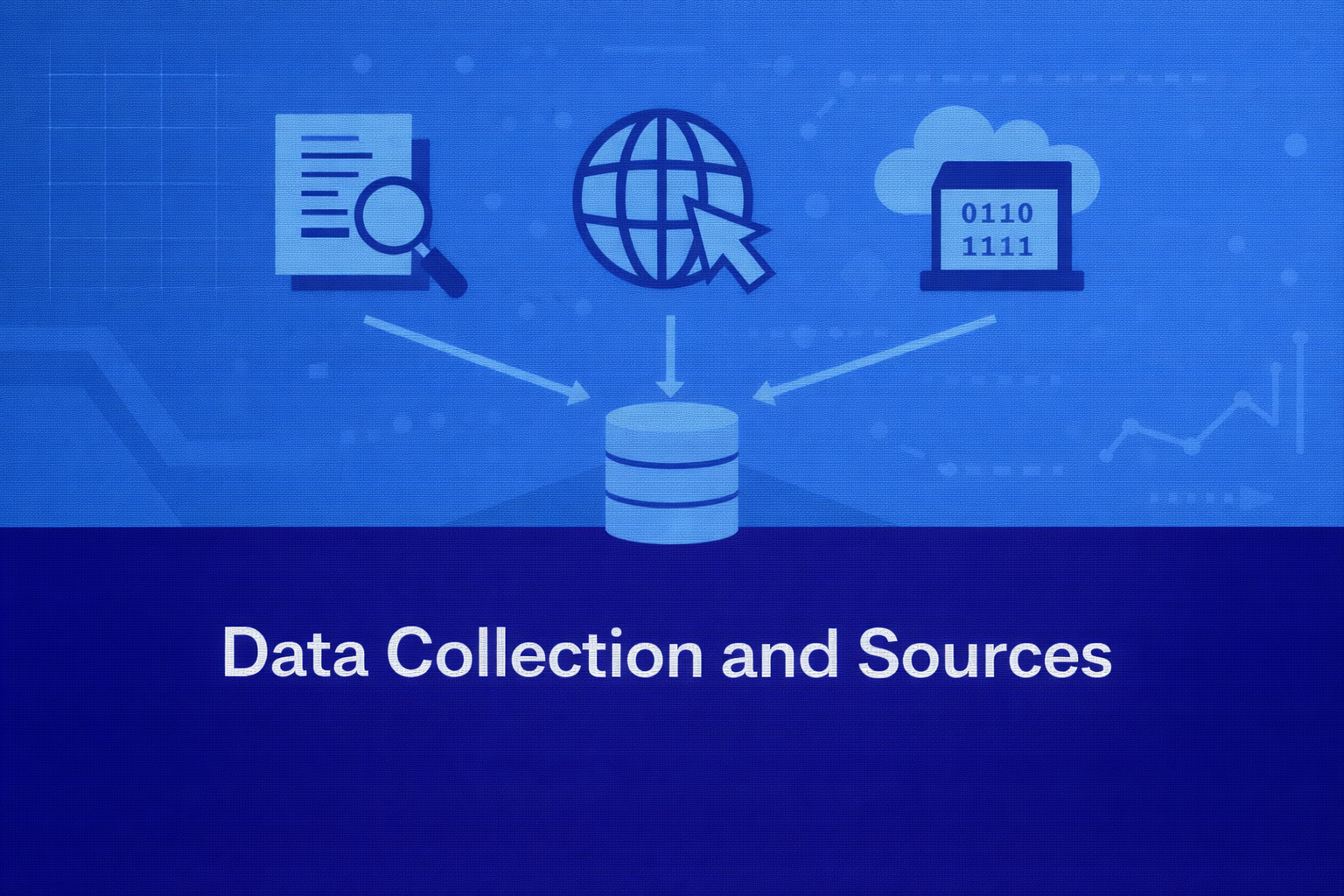
Among these sources, three of the most common methods for acquiring machine learning data are:
- Application Programming Interfaces (APIs)
- Web scraping
- Public datasets
Each of these methods plays an important role in modern ML pipelines, enabling organizations to access large volumes of data for training and experimentation.
Understanding these collection techniques allows practitioners to design scalable and efficient data pipelines.
Importance of Data Collection in ML Systems
Before exploring the methods of data collection, it is important to understand why data acquisition is such a critical component of machine learning systems.
High-quality data enables models to:
- Learn meaningful patterns
- Reduce bias and noise
- Improve predictive accuracy
- Generalize to new situations
Poor data collection practices can result in:
- Incomplete datasets
- Data bias
- Inaccurate predictions
- Model failure in production
Therefore, the effectiveness of an ML model often depends more on the quality of the data than the complexity of the algorithm used.
Data Collection Through APIs
Definition
Application Programming Interfaces (APIs) provide a structured way for applications to request and retrieve data from external systems.
APIs act as intermediaries that allow developers to access services and data without directly interacting with the underlying database or infrastructure.
How APIs Work
An API typically operates through a request-response mechanism:
- A client sends a request to an API endpoint.
- The API processes the request.
- The server returns data in a structured format, often JSON or XML.
Example request:
A machine learning system might query a weather API to retrieve temperature and humidity data for predictive modeling.
Common API Data Sources
Many organizations provide APIs for accessing data, including:
- Social media platforms
- Financial markets
- Weather services
- Geolocation services
- e-commerce platforms
- government data portals
Examples of commonly used APIs include:
- Twitter API for social media analytics
- OpenWeather API for environmental data
- Google Maps API for geospatial information
- Stripe API for financial transactions
Role in ML Pipelines
APIs are frequently used for:
- Collecting real-time data
- Updating datasets dynamically
- Integrating external data sources
- Enriching internal datasets
For example, a ride-sharing platform might use APIs to collect:
- traffic conditions
- weather information
- map data
These variables can improve demand prediction models.
Advantages of APIs
Using APIs offers several benefits:
- Structured data formats
- Reliable and documented access
- Automated data retrieval
- Real-time updates
Challenges
Despite their benefits, APIs may present challenges such as:
- Rate limits
- Authentication requirements
- Usage costs
- Dependency on third-party services
Machine learning engineers often design automated pipelines to handle API limitations through caching and scheduling mechanisms.
Data Collection Through Web Scraping
Definition
Web scraping is the automated process of extracting data from websites.
Unlike APIs, which provide structured access to data, web scraping retrieves information directly from web pages by parsing HTML content.
How Web Scraping Works
Web scraping typically involves the following steps:
- Sending HTTP requests to web pages
- Retrieving HTML content
- Parsing the page structure
- Extracting relevant information
- Storing the data in structured form
Popular tools used for web scraping include:
- BeautifulSoup
- Scrapy
- Selenium
- Puppeteer
Example Use Case
An organization building a price comparison platform may scrape product information from multiple online retailers.
The collected data may include:
- Product names
- Prices
- Ratings
- Reviews
This information can be used to train recommendation models or pricing algorithms.
Applications in Machine Learning
Web scraping supports various ML applications such as:
- sentiment analysis from customer reviews
- market research
- news trend analysis
- competitive intelligence
- dataset creation for natural language processing
Challenges of Web Scraping
Although web scraping can collect large amounts of data, it introduces several technical and ethical challenges.
Technical challenges include:
- changing website layouts
- dynamic content loading
- anti-bot protections
- large-scale data management
Ethical and legal considerations include:
- respecting website terms of service
- avoiding excessive server requests
- complying with data privacy regulations
Responsible scraping practices are essential to avoid legal issues and maintain ethical standards.
Public Datasets
Definition
Public datasets are collections of data made available by organizations, research institutions, or governments for public use.
These datasets are commonly used for machine learning research, benchmarking, and model training.
Sources of Public Datasets
Several platforms host publicly available datasets for machine learning.
Common sources include:
- academic research repositories
- government data portals
- machine learning competitions
- open data initiatives
Examples of popular dataset platforms include:
- Kaggle
- UCI Machine Learning Repository
- Google Dataset Search
- Hugging Face datasets
- OpenML
Types of Public Data
Public datasets exist for many domains, including:
- healthcare data
- financial markets
- transportation data
- environmental data
- image and video datasets
- natural language datasets
Examples include:
Image datasets:
- ImageNet
- CIFAR-10
Text datasets:
- IMDB movie reviews
- Wikipedia text corpora
Tabular datasets:
- Titanic survival dataset
- housing price datasets
Benefits of Public Datasets
Public datasets provide several advantages for machine learning practitioners.
They allow researchers and developers to:
- experiment with models
- benchmark algorithms
- test new ideas
- compare model performance
They are especially valuable for students and researchers who may not have access to proprietary data.
Limitations
Despite their usefulness, public datasets may present certain limitations.
These include:
- outdated information
- limited scale
- domain bias
- lack of real-world complexity
Therefore, production systems often rely on proprietary or continuously updated datasets.
Integrating Data Sources into ML Pipelines
Machine learning pipelines must combine data from multiple sources to produce reliable models.
A typical data pipeline may include the following steps:
Data ingestion
Data from APIs, web scraping, and public datasets is collected.
Data storage
Raw data is stored in data lakes, databases, or distributed storage systems.
Data preprocessing
Cleaning, normalization, and transformation steps prepare the data for modeling.
Feature engineering
Relevant attributes are extracted or created from the collected data.
Model training
Prepared datasets are used to train machine learning models.
Model monitoring
New data continues to be collected and used for retraining models.
Automation tools such as Apache Airflow, Kafka, and Spark are often used to orchestrate large-scale data pipelines.
Data Quality Considerations
High-quality data collection requires attention to several factors.
Important considerations include:
- data accuracy
- data completeness
- data consistency
- data freshness
- data security
Organizations must also ensure compliance with privacy regulations such as GDPR or other regional data protection laws.
Conclusion
Data collection is a foundational step in the machine learning lifecycle. Without reliable and diverse data sources, even the most advanced algorithms cannot produce meaningful results. APIs, web scraping, and public datasets represent three of the most widely used methods for gathering data in modern ML pipelines.
APIs provide structured access to real-time data, web scraping enables extraction of information from web content, and public datasets offer accessible resources for experimentation and benchmarking. Each method presents unique advantages and challenges, and successful ML systems often integrate multiple sources to create comprehensive datasets.
As machine learning applications continue to expand across industries, the ability to collect, manage, and integrate diverse data sources will remain a critical skill for data scientists, machine learning engineers, and AI practitioners.