
Critical Interview Questions and How to Approach Them
Abstract
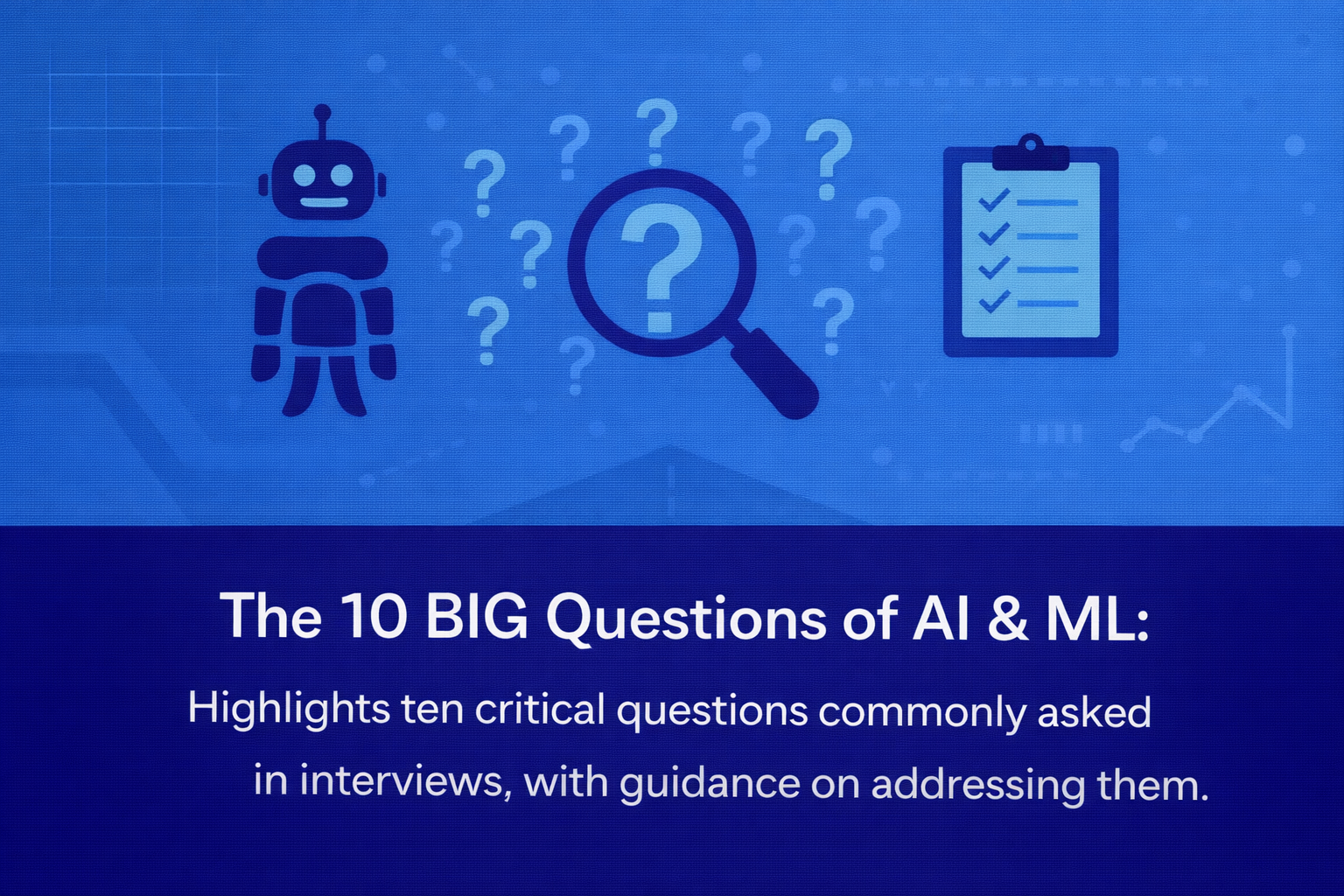
Artificial Intelligence and Machine Learning interviews often revolve around a set of fundamental questions that evaluate a candidate’s conceptual clarity, problem-solving ability, and understanding of real-world AI systems. These questions typically focus on model design, data challenges, evaluation strategies, and deployment considerations. Rather than expecting memorized answers, interviewers assess how candidates reason through problems and justify their decisions. This paper highlights ten of the most important questions frequently asked in AI and ML interviews and provides structured guidance on how candidates can approach them effectively.
Introduction
AI and ML roles require both theoretical knowledge and practical problem-solving skills. Interviewers therefore use open-ended questions to evaluate a candidate’s ability to think critically about data, models, evaluation metrics, and system constraints.
These questions often appear in slightly different forms across interviews but typically revolve around core topics such as:
- Model selection
- Handling data limitations
- Improving model performance
- Avoiding overfitting
- Evaluating models correctly
- Scaling systems for production
Understanding the reasoning behind these questions helps candidates respond confidently and demonstrate a strong grasp of machine learning principles.
The following ten questions represent some of the most commonly asked topics in AI and ML interviews.
Question 1: How Do You Choose the Right Machine Learning Model?
One of the most fundamental questions interviewers ask is how to select an appropriate model for a given problem.
A strong answer should explain that model selection depends on several factors:
- Type of problem (classification, regression, clustering)
- Dataset size
- Feature complexity
- Interpretability requirements
- Computational constraints
Candidates should emphasize that the process usually begins with simple baseline models, followed by more complex approaches if necessary.
For example, logistic regression or decision trees may serve as initial baselines for classification tasks, while gradient boosting or neural networks may be explored if performance improvements are required.
Interviewers expect candidates to demonstrate that model choice is driven by data characteristics and problem requirements rather than personal preference.
Question 2: How Do You Handle Missing or Incomplete Data?
Real-world datasets frequently contain missing values, making data preprocessing an essential step in machine learning pipelines.
Candidates should explain common strategies such as:
- Removing rows with missing values
- Imputing values using mean, median, or mode
- Using predictive imputation techniques
- Leveraging models that handle missing values inherently
The key point is that the chosen approach depends on the nature and scale of missing data. For example, removing rows may work when only a small percentage of data is missing but becomes problematic when large portions of the dataset are incomplete.
Interviewers are interested in whether candidates consider data quality before model development.
Question 3: How Do You Handle Imbalanced Datasets?
Many real-world ML problems involve highly imbalanced data. Examples include fraud detection, disease diagnosis, and rare event prediction.
Candidates should discuss techniques such as:
- Oversampling minority classes
- Undersampling majority classes
- Synthetic data generation methods like SMOTE
- Using class-weighted loss functions
- Choosing appropriate evaluation metrics
It is important to highlight that accuracy alone is insufficient for imbalanced datasets. Metrics such as precision, recall, and F1-score provide more meaningful insights.
Demonstrating awareness of these challenges indicates strong practical knowledge.
Question 4: How Do You Detect and Prevent Overfitting?
Overfitting occurs when a model performs well on training data but fails to generalize to new data.
Interviewers expect candidates to explain both detection methods and prevention strategies.
Detection methods include monitoring the gap between training and validation performance. If training accuracy is high while validation accuracy is significantly lower, overfitting is likely occurring.
Common mitigation techniques include:
- Cross-validation
- Regularization
- Simplifying the model
- Early stopping
- Increasing training data
Candidates who discuss the importance of generalization demonstrate strong understanding of machine learning fundamentals.
Question 5: What Metrics Would You Use to Evaluate Your Model?
Evaluation metrics depend heavily on the problem type.
For classification tasks, common metrics include accuracy, precision, recall, F1-score, and ROC-AUC. For regression problems, metrics such as mean squared error and mean absolute error are typically used.
Candidates should also explain why a particular metric is appropriate.
For instance, in medical diagnosis, minimizing false negatives may be more important than maximizing overall accuracy. Therefore, recall becomes a critical metric.
This question evaluates whether candidates understand the relationship between business objectives and model evaluation.
Question 6: How Do You Improve Model Performance?
Improving model performance involves multiple strategies beyond simply changing algorithms.
Candidates should mention techniques such as:
- Feature engineering
- Hyperparameter tuning
- Data augmentation
- Ensemble methods
- Increasing training data
Feature engineering is often the most impactful improvement method because it enhances how models interpret patterns in data.
Interviewers typically look for candidates who understand that better data and features often outperform more complex models.
Question 7: How Would You Deploy a Machine Learning Model?
Deployment is a critical step in transforming a trained model into a usable system.
Candidates should explain the typical deployment pipeline, which includes:
- Packaging the trained model
- Creating prediction APIs
- Integrating with production systems
- Monitoring model performance
Modern deployment strategies often use containerization technologies and cloud infrastructure.
Candidates may also discuss batch predictions versus real-time inference depending on the application requirements.
This question tests whether candidates understand end-to-end ML system design.
Question 8: How Do You Handle Concept Drift?
Concept drift occurs when the statistical properties of input data change over time, causing model performance to degrade.
Examples include:
- Changes in consumer behavior
- New fraud patterns
- Shifts in economic conditions
Candidates should explain monitoring strategies such as:
- Tracking prediction accuracy over time
- Monitoring feature distributions
- Implementing automated retraining pipelines
Handling concept drift ensures that models remain effective as real-world conditions evolve.
Question 9: How Do You Balance Model Accuracy and Interpretability?
This question relates to a key trade-off in machine learning systems.
Highly complex models such as deep neural networks often produce better predictions but lack transparency. Simpler models such as linear regression are easier to interpret but may capture fewer patterns.
Candidates should explain that the choice depends on the application context.
For example:
- Healthcare and finance may require interpretable models for regulatory reasons.
- Recommendation systems may prioritize predictive performance.
Interviewers look for candidates who understand that model design involves trade-offs rather than absolute solutions.
Question 10: What Would You Do If Your Model Performs Poorly?
This question evaluates a candidate’s debugging and diagnostic skills.
Candidates should outline a systematic troubleshooting approach.
Possible steps include:
- Checking data quality and labeling errors
- Reviewing feature engineering
- Testing different algorithms
- Analyzing training and validation performance
- Evaluating data leakage issues
The most important aspect of this answer is demonstrating structured problem-solving rather than random experimentation.
Strong candidates show how they would analyze the issue methodically and improve the system.
Why These Questions Matter
These ten questions cover the most important aspects of machine learning system design:
- Data preparation
- Model selection
- Performance evaluation
- Deployment and monitoring
- Real-world constraints
Interviewers use these questions to determine whether candidates can build and maintain production-ready ML systems rather than simply train models in isolation.
Conclusion
AI and ML interviews frequently revolve around a core set of conceptual questions that reveal a candidate’s understanding of machine learning systems. By preparing structured responses to these ten critical questions, candidates can demonstrate both technical expertise and practical experience.
Strong answers emphasize problem understanding, data considerations, model design, evaluation strategies, and production deployment. Candidates who approach these questions systematically show that they are capable of designing AI solutions that work not only in theory but also in real-world environments.
Mastering these foundational questions equips aspiring AI professionals with the confidence and clarity needed to succeed in interviews and to build effective machine learning systems in practice.