
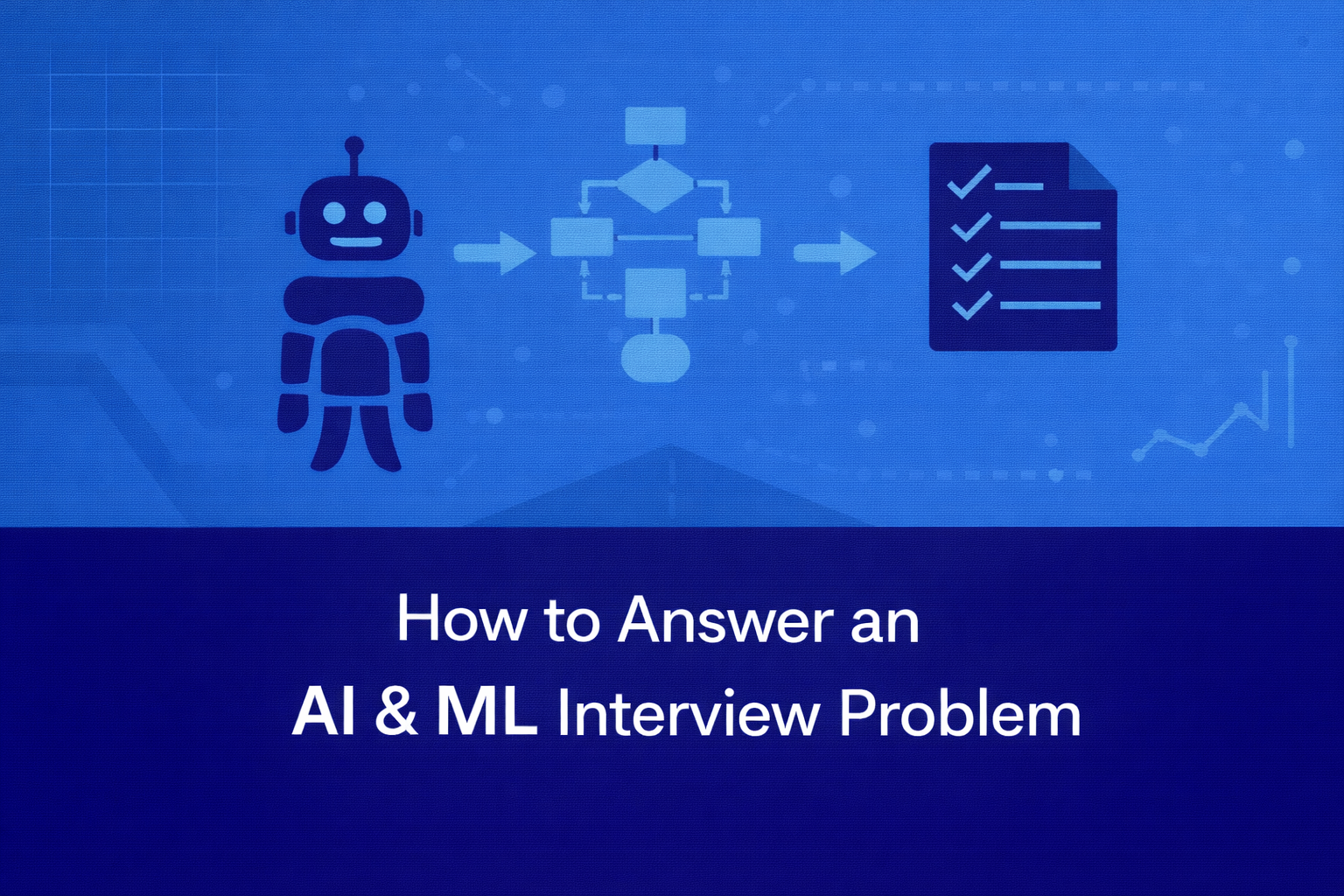
A Structured Approach to Tackling AI Design Questions
Abstract
Artificial Intelligence and Machine Learning interviews often evaluate more than technical knowledge. Interviewers assess a candidate’s ability to structure problems, reason about data, select appropriate models, evaluate trade-offs, and communicate solutions clearly. Many candidates struggle not because they lack knowledge, but because they approach problems without a systematic framework. This paper presents a structured methodology for answering AI and ML interview questions effectively. It outlines a step-by-step approach that helps candidates analyze the problem, design a solution, justify decisions, and demonstrate practical understanding of real-world AI systems.
Introduction
AI and Machine Learning interviews frequently involve open-ended design questions such as:
- “Design a recommendation system for an e-commerce platform.”
- “How would you detect fraudulent transactions using machine learning?”
- “Build a system to classify medical images for disease detection.”
- “Design an AI model for predicting customer churn.”
These questions are not meant to test memorized answers. Instead, interviewers evaluate how candidates think through complex problems, break them into manageable components, and propose realistic solutions.
A strong response typically demonstrates:
- Structured problem-solving
- Understanding of ML fundamentals
- Awareness of real-world constraints
- Ability to explain trade-offs
- Clear communication
Using a systematic framework helps candidates organize their thoughts and present answers confidently.
Step 1: Clarify the Problem
The first step is to ensure a clear understanding of the problem before proposing a solution. Many candidates rush directly into model selection without analyzing the business objective.
Key questions to ask include:
- What is the exact problem we are solving?
- Is it a classification, regression, ranking, or clustering problem?
- What are the business goals and success metrics?
- What are the constraints such as latency, scalability, or interpretability?
Clarifying assumptions demonstrates analytical thinking and prevents incorrect solutions.
Example
If the problem is “Design a spam detection system,” the candidate should clarify:
- Is it email spam or messaging spam?
- What is the acceptable false positive rate?
- How quickly must predictions be generated?
This ensures the solution aligns with real-world expectations.
Step 2: Define the Machine Learning Formulation
Once the problem is understood, the next step is to translate it into a machine learning formulation.
Typical formulations include:
- Classification – predicting discrete categories
- Regression – predicting numerical values
- Ranking – ordering items based on relevance
- Clustering – grouping similar data points
- Reinforcement learning – learning through interaction
Example
Predicting whether a transaction is fraudulent becomes a binary classification problem.
Predicting house prices becomes a regression problem.
Clearly defining the ML formulation shows that the candidate understands how business problems translate into ML tasks.
Step 3: Discuss Data Requirements
Machine learning systems depend heavily on data quality and availability. Interviewers expect candidates to discuss how data will be collected, processed, and prepared.
Important considerations include:
- Data sources
- Data labeling
- Feature engineering
- Handling missing or noisy data
- Data imbalance
Example
For a recommendation system, possible data sources may include:
- User browsing history
- Purchase history
- Product metadata
- User ratings and reviews
Discussing data pipelines and preprocessing demonstrates practical experience with ML systems.
Step 4: Feature Engineering
Feature engineering plays a crucial role in model performance. Candidates should explain which features might influence predictions and why.
Common types of features include:
- Behavioral features
- Temporal features
- Text-based features
- Numerical features
- Aggregated statistics
Example
In a fraud detection system, useful features might include:
- Transaction amount
- Transaction frequency
- Location mismatch
- Time of transaction
- User spending patterns
Good feature design often improves performance more than complex models.
Step 5: Model Selection
After defining the problem and preparing data, the candidate should propose suitable models.
It is usually beneficial to start with simple baseline models before suggesting advanced techniques.
Typical progression might include:
Baseline models
- Logistic regression
- Decision trees
Intermediate models
- Random forests
- Gradient boosting
Advanced models
- Deep neural networks
- Transformer architectures
Candidates should also explain why a particular model is appropriate for the given task.
Example
For structured tabular data, gradient boosting models such as XGBoost often perform well.
For image classification tasks, convolutional neural networks are more suitable.
This step demonstrates familiarity with machine learning algorithms and their practical use cases.
Step 6: Model Evaluation
Once a model is proposed, the candidate should discuss how to measure its performance.
Evaluation metrics depend on the problem type.
Common classification metrics include:
- Accuracy
- Precision
- Recall
- F1-score
- ROC-AUC
Regression metrics include:
- Mean Squared Error (MSE)
- Root Mean Squared Error (RMSE)
- Mean Absolute Error (MAE)
Example
In fraud detection, accuracy alone may be misleading because fraud cases are rare. Metrics such as precision, recall, and F1-score are more appropriate.
This shows awareness of real-world evaluation challenges.
Step 7: Handling Practical Constraints
AI systems must operate under practical constraints such as:
- Latency requirements
- Hardware limitations
- Scalability
- Data privacy
- Regulatory requirements
Interviewers often expect candidates to discuss these constraints.
Example
In a real-time recommendation system, predictions must be generated within milliseconds. This may require model optimization or caching strategies.
Discussing deployment considerations shows system-level thinking.
Step 8: Deployment and Monitoring
A complete AI solution does not end with model training. Production systems require monitoring and continuous improvement.
Important aspects include:
- Model deployment pipelines
- Monitoring model performance
- Detecting data drift
- Retraining strategies
Example
A fraud detection system must be retrained regularly because fraud patterns evolve over time.
Candidates who discuss monitoring and retraining demonstrate strong practical awareness.
Step 9: Explain Trade-offs
Strong candidates acknowledge trade-offs in AI systems.
Examples include:
- Accuracy versus interpretability
- Speed versus complexity
- Data volume versus model performance
Discussing trade-offs indicates a mature understanding of AI system design.
Example
A deep learning model might achieve higher accuracy but be harder to explain compared to a logistic regression model.
Depending on regulatory requirements, the simpler model might be preferred.
Step 10: Summarize the Solution
The final step is to summarize the proposed approach clearly.
A concise summary might include:
- Problem definition
- Data strategy
- Model selection
- Evaluation metrics
- Deployment considerations
This helps interviewers see the complete solution and reinforces the candidate’s structured thinking.
Example Interview Flow
Consider the question:
“Design a machine learning system to predict customer churn.”
A structured response might follow this sequence:
- Clarify the objective and define churn.
- Frame the problem as a classification task.
- Identify data sources such as customer activity and billing history.
- Engineer features like usage patterns and service complaints.
- Train baseline models such as logistic regression and gradient boosting.
- Evaluate using precision, recall, and ROC-AUC.
- Deploy the model within a customer analytics pipeline.
- Monitor performance and retrain periodically.
This structured approach demonstrates both technical depth and clear communication.
Common Mistakes in AI Interviews
Candidates often make several mistakes when answering AI design questions.
One common mistake is jumping directly to deep learning models without discussing data or simpler baselines.
Another mistake is ignoring evaluation metrics or failing to explain how models will be deployed and maintained.
Finally, some candidates provide overly theoretical answers without considering practical constraints such as latency or scalability.
Avoiding these mistakes improves interview performance significantly.
Conclusion
AI and Machine Learning interview questions are designed to evaluate problem-solving ability, system thinking, and communication skills rather than just technical knowledge. A structured framework helps candidates organize their thoughts and demonstrate a comprehensive understanding of AI system design.
By following a step-by-step approach—clarifying the problem, defining the ML formulation, discussing data and features, selecting appropriate models, evaluating performance, addressing practical constraints, and summarizing the solution—candidates can answer AI interview questions confidently and effectively.
Mastering this structured methodology enables candidates not only to succeed in interviews but also to design robust AI systems in real-world applications.